Noun (Basic ㊦ 133)
A dependant noun which expresses the speaker’s expectation that something will take place or took place or that someone/something is or was in some state.
Equivalent: I expect that ~; it is expected that ~; ~ is expected to; I am fairly certain that ~; should; ought to; it is natural that ~; no wonder ~
| (1) {V/Adjectiveい} informal | はずだ | |
| {話す /話した} はずだ | It is expected that someone will talk/talked. | |
| {高い /高かった} はずだ | It is expected that something is/was expensive. | |
| (2) Adjective な stem | [な / だった] はずだ | |
| {静かな/静かだった} はずだ | It is expected that something is/was quiet. | |
| (3) Noun | {の/だった} はずだ | |
| {先生の /先生だった} はずだ | It is expected that s.o. is/was a teacher |
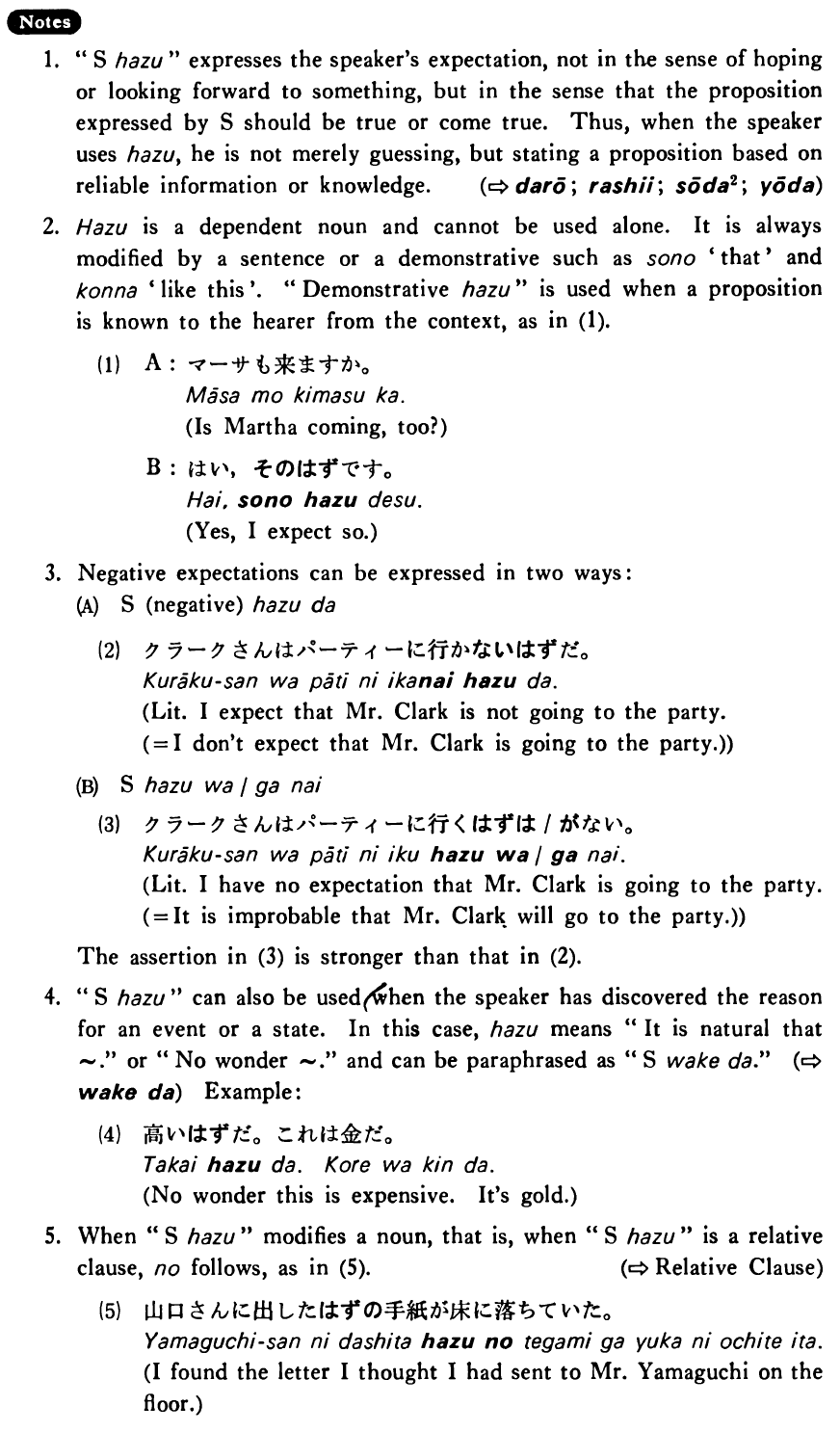
1. "Sentenceはず" expresses the speakers expectation, not in the sense of hoping or looking forward to something, but in the sense that the proposition expressed by Sentence should be true or come true. Thus, when the speaker uses はず he is not merely guessing, but stating a proposition based on reliable information or knowledge.
2. はず is a dependent noun and cannot be used alone. It is always modified by a sentence or a demonstrative such as その 'that' and こんな 'like this'. "Demonstrative はず" is used when a proposition is known to the hearer from the context, as in (1).
3. Negative expectations can be expressed in two ways:
(A) Sentence (negative) はずだ
(B) Sentenceはずは/がない
The assertion in (3) is stronger than that in (2).
4. "Sentenceはず" can also be used when the speaker has discovered the reason for an event or a state. In this case, はず means "It is natural that ~." or "No wonder ~." and can be paraphrased as "Sentenceわけだ." (⇨ わけだ) Example:
5. When "Sentenceはず" modifies a noun, that is, when "Sentenceはず" is a relative clause, の follows, as in (5).
(⇨ Relative Clause)